1:5:5 Sourdough Starter Feeding Ratio: The Overnight Method
What Is a 1:5:5 Feeding Ratio?
A 1:5:5 feed means you add five times the weight of flour and five times the weight of water for every one part of mature starter. For example, 10 g of starter + 50 g of flour + 50 g of water gives a 110 g levain at 100% hydration. The high dilution slows fermentation dramatically — which is exactly the point.
Why Bakers Use 1:5:5
1:5:5 has become the go-to ratio for three specific scenarios:
- Overnight levains. You mix it before bed and it peaks the next morning, right when you’re ready to mix dough.
- Cool kitchens. In winter, even a warmer ratio like 1:1:1 can take 12 hours to peak — but 1:5:5 matches that timing predictably.
- Mild-flavoured loaves. Higher dilution = slower acid build-up = cleaner wheat flavour. Favoured for high-hydration baguettes, country loaves where flour notes should shine, and enriched doughs.
Peak Time: What to Expect
The peak window is forgiving, but here’s the temperature map:
- 65°F (18°C): 14–16 hours
- 70°F (21°C): 12–14 hours
- 75°F (24°C): 10–12 hours
- 80°F (27°C): 8–10 hours
Mix your 1:5:5 levain at 10 p.m. in a 72°F kitchen and it will be perfectly domed by 8 a.m. For tighter precision, see the fermentation temperature guide.
How to Build a 1:5:5 Levain — Step by Step
- Start with an active, recently fed starter. A sluggish starter cannot survive the high dilution and will simply never peak. Feed at 1:1:1 4–5 hours before building the levain to ensure it’s at full strength.
- Weigh 10 g of that peak mature starter into a tall, clean jar. Tall matters — the levain will expand 3× during fermentation.
- Add 50 g cool water (65°F / 18°C if your kitchen is warm, otherwise room-temperature). Stir to dissolve.
- Add 50 g flour — bread flour or a 90/10 bread-to-whole-wheat blend works beautifully. Stir until smooth.
- Mark the starting height and cover loosely. Leave at your overnight temperature.
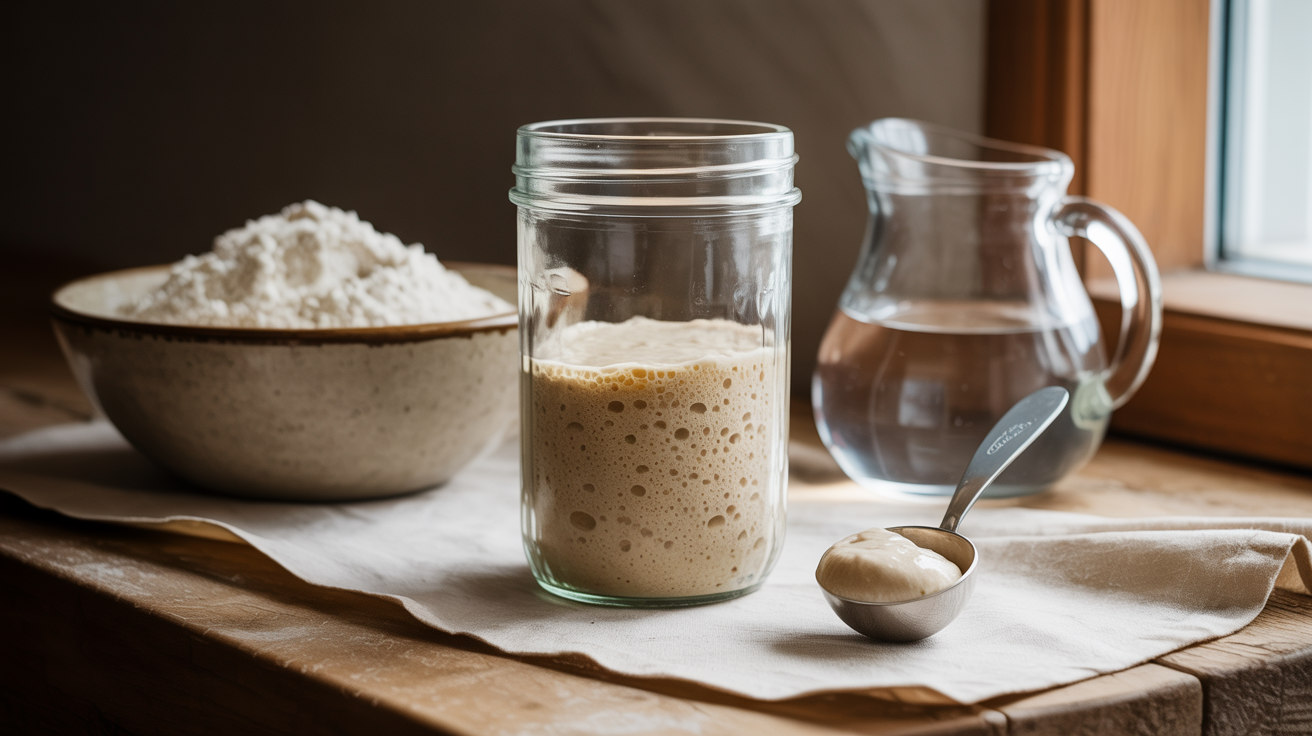
- Check at the earliest end of the window. A peaked 1:5:5 is domed, porous, and floats when a spoonful is dropped in water.
1:5:5 vs 1:1:1 vs 1:2:2 — Which to Pick?
| Ratio | Best for | Peak @ 72°F | Flavour |
|---|---|---|---|
| 1:1:1 | Same-day baking, maintaining starter | 4–6 h | Tangy |
| 1:2:2 | Morning feed, afternoon bake | 6–8 h | Balanced |
| 1:5:5 | Overnight levain, cool kitchens | 10–14 h | Mild, clean |
For same-day bakes, stick with 1:1:1 or 1:2:2 / 1:3:3. Reach for 1:5:5 only when you want a deliberately long, overnight fermentation.
Common Mistakes With 1:5:5
Starting With a Weak Starter
This is the #1 failure mode. A 1:5:5 feed doesn’t build a starter — it tests one. If the starter you use isn’t genuinely active (passed the float test, doubled recently), the dilution is too aggressive and your levain will just sit flat. Always pre-feed at 1:1:1 first.
Using Cold Flour
Cold flour drops the mix temperature, which can push peak time past 16 hours. Keep flour at room temperature, especially in winter. If your kitchen is under 68°F, a desired dough temperature calculation helps you hit the right final mix temp.
Missing the Peak
Even 1:5:5 peaks and falls. If you wake up to a collapsed levain that smells of acetone, you’ve gone too far. Use it anyway (it’ll still bake), but your loaf will be slightly tangier than intended.
How Much Levain Do You Need?
Most artisan recipes call for a levain weighing 20% of the total flour in the final dough. For a 500 g flour loaf:
- Levain weight: 500 × 0.20 = 100 g
- 1:5:5 build to reach 100 g: divide 100 by 11 ≈ 9 g of starter, plus 45 g each flour and water
Our sourdough calculator generates these numbers for any loaf size automatically.
FAQ
Does a 1:5:5 feed work with whole wheat flour?
Yes, but whole-wheat flour is more active than white, so peak time shortens by 10–20%. For a whole-wheat 1:5:5 at 70°F, expect 10–12 hours instead of 12–14.
Can I maintain a starter at 1:5:5 long term?
Not daily. 1:5:5 is a build ratio rather than a maintenance ratio. Long-term maintenance works best at 1:1:1 or 1:2:2, with 1:5:5 reserved for the night before a bake.
What if my levain doesn’t peak overnight?
Three causes: starter wasn’t active, kitchen is too cold, or flour is old. Warm the kitchen to 72°F and wait another 2–3 hours — it usually catches up. If not, feed the levain 1:1:1 and start the 1:5:5 build over tomorrow.
Is 1:5:5 the same as a stiff levain?
No. A stiff levain uses less water than flour (often 50–60% hydration) to slow fermentation via low moisture. 1:5:5 is still 100% hydration — it slows fermentation via dilution, not stiffness.
Next Steps
Once your overnight levain has peaked, mix it into a recipe using our free sourdough calculator or follow the calculator workflow guide to dial in your bake.