How to Calculate Sourdough Hydration: A Beginner's Guide
Understanding Hydration
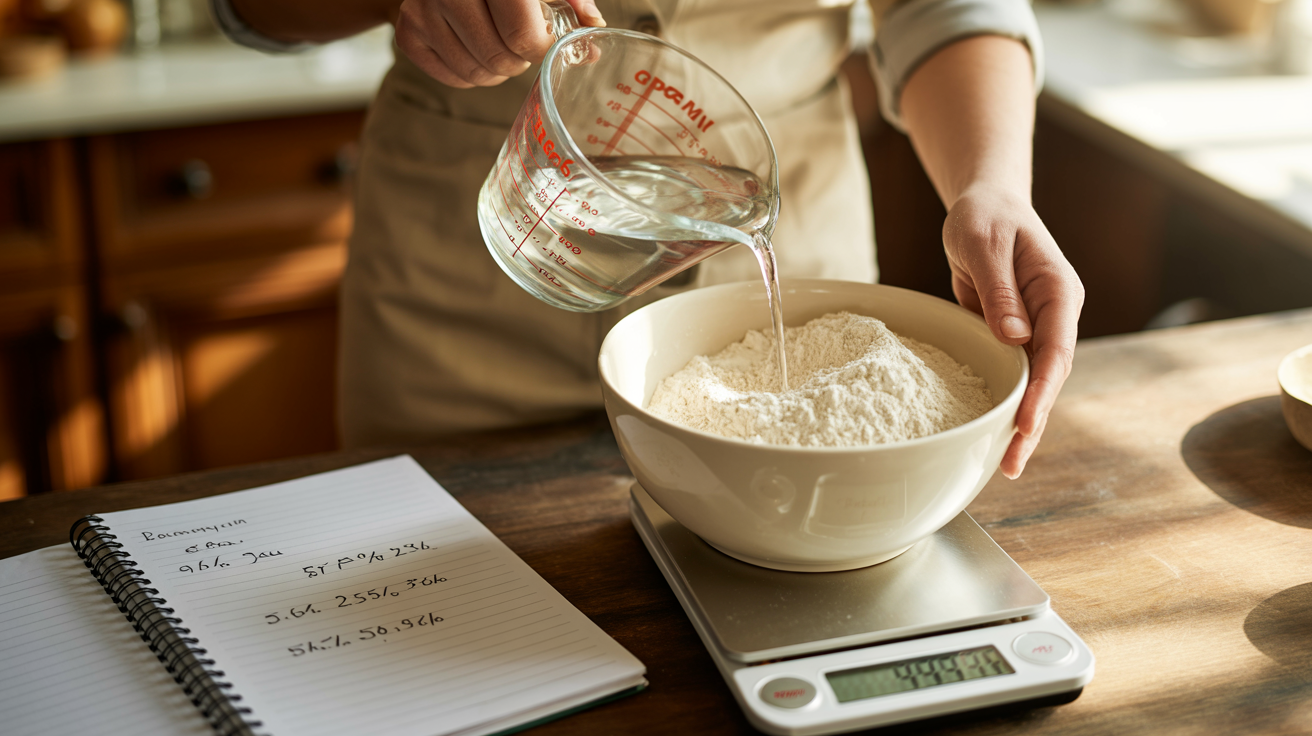
Hydration is the ratio of water to flour in your dough, expressed as a percentage. It is the single most influential variable in sourdough baking because it controls crumb openness, crust thickness, handling difficulty, and oven spring.
The Basic Formula
Hydration % = (Water Weight ÷ Flour Weight) × 100
For example, if you have 500 g of flour and 375 g of water:
375 ÷ 500 × 100 = 75% hydration
What Different Hydration Levels Mean
- 60–65%: Stiff dough, easier to handle, tighter crumb. Good for sandwich loaves.
- 70–75%: Standard sourdough. Balanced handling and open crumb. Best for beginners.
- 80–85%: High hydration. Extensible, open crumb, requires folding technique.
- 90%+: Very high hydration. Challenging, very open crumb, ciabatta-style.
Don’t Forget Your Starter
A 100%-hydration starter is half water, half flour by weight. If your recipe uses 100 g of starter, that’s 50 g of flour and 50 g of water added to your final dough. Our calculator handles this automatically.
Practical Tips
When starting out, target 75% hydration. It’s a sweet spot that gives you a manageable dough with good oven spring and a moderately open crumb.
Use our free sourdough calculator to experiment with different hydration levels and see exactly how it affects your recipe.